Most restaurant owners start hunting for a chatbot after missing a Friday dinner rush of WhatsApp orders. The old approach of answering every DM by hand breaks down once delivery questions, table bookings and menu requests pile up across four channels at once. Some platforms also nickel-and-dime you on message volume right when volume grows.
This guide ranks the 10 best chatbots for restaurants in 2026 and explains what separates a tool that fills tables from one that just answers FAQs. You will get concrete criteria for comparing platforms, a clear number one pick in Com.bot, and enough detail on each option to decide which fits your menu, your channels and your budget.
What to Look For in Restaurant Chatbots
Restaurant chatbots in 2026 must handle far more than FAQs, they need to process orders, book tables, and connect with your POS without friction. The right platform turns a website widget into a working member of the floor team. The wrong one adds another inbox nobody checks.
Use the seven criteria below as a checklist when comparing the ten tools in this roundup. Each one maps to a real task your staff currently does by hand.
POS integration (Toast, Square). This is the dealbreaker. A bot that cannot read your live menu will happily sell a dish you ran out of two hours ago. POS system connectivity keeps items, prices, and availability in sync so every order the bot takes is one the kitchen can actually fill. Ask vendors how often the sync runs and what happens during an outage.
Multi-channel support. Diners do not all live in the same app. WhatsApp integration, Facebook Messenger bots, SMS chatbots, website chat widgets, and Google Business Messages each reach a different crowd. A platform that covers several channels meets customers where they already are, instead of forcing them to download something new.
Natural language processing. Guests type "do you have anything gluten free for a kid" not "filter: gluten-free, party size: 4." Strong natural language processing and intent recognition handle that messiness across multi-turn dialogue. Modern large language models make this feel like texting a knowledgeable host rather than navigating a phone tree.
Payment processing integration. An AI ordering assistant that takes the order but cannot take the card creates extra steps for staff. Built-in payment processing integration lets guests pay inside the conversation, which matters most for pickup and delivery. Confirm the bot supports your existing processor before committing.
Reservation booking and table management. Reservation booking bots should check real availability, not collect requests for a human to reconcile later. Tie-ins with table management software prevent double bookings and no-show surprises. Test this on a busy Friday configuration, not a quiet Tuesday.
Upselling and menu recommendation engines. A good server suggests the wine that pairs with the steak. Menu recommendation engines and upselling algorithms bring that instinct to chat, nudging add-ons and larger sizes at the right moment. The best ones read context, so a dessert prompt lands after the entree, not before.
Analytics, sentiment analysis, and order tracking. Conversations are data. Sentiment analysis flags unhappy guests before they post a review, and order tracking cuts "where is my food" calls. Look for dashboards that show what people ask for and what they abandon, so you can fix the menu or the flow.
Weigh these criteria against your operation. A quick-service spot may prioritize payment and order tracking, while a full-service restaurant lives or dies on reservations and table management. Judge each of the ten tools in this roundup on how well it matches your mix, using publicly available feature information and pricing.
1. Com.bot - Best Overall
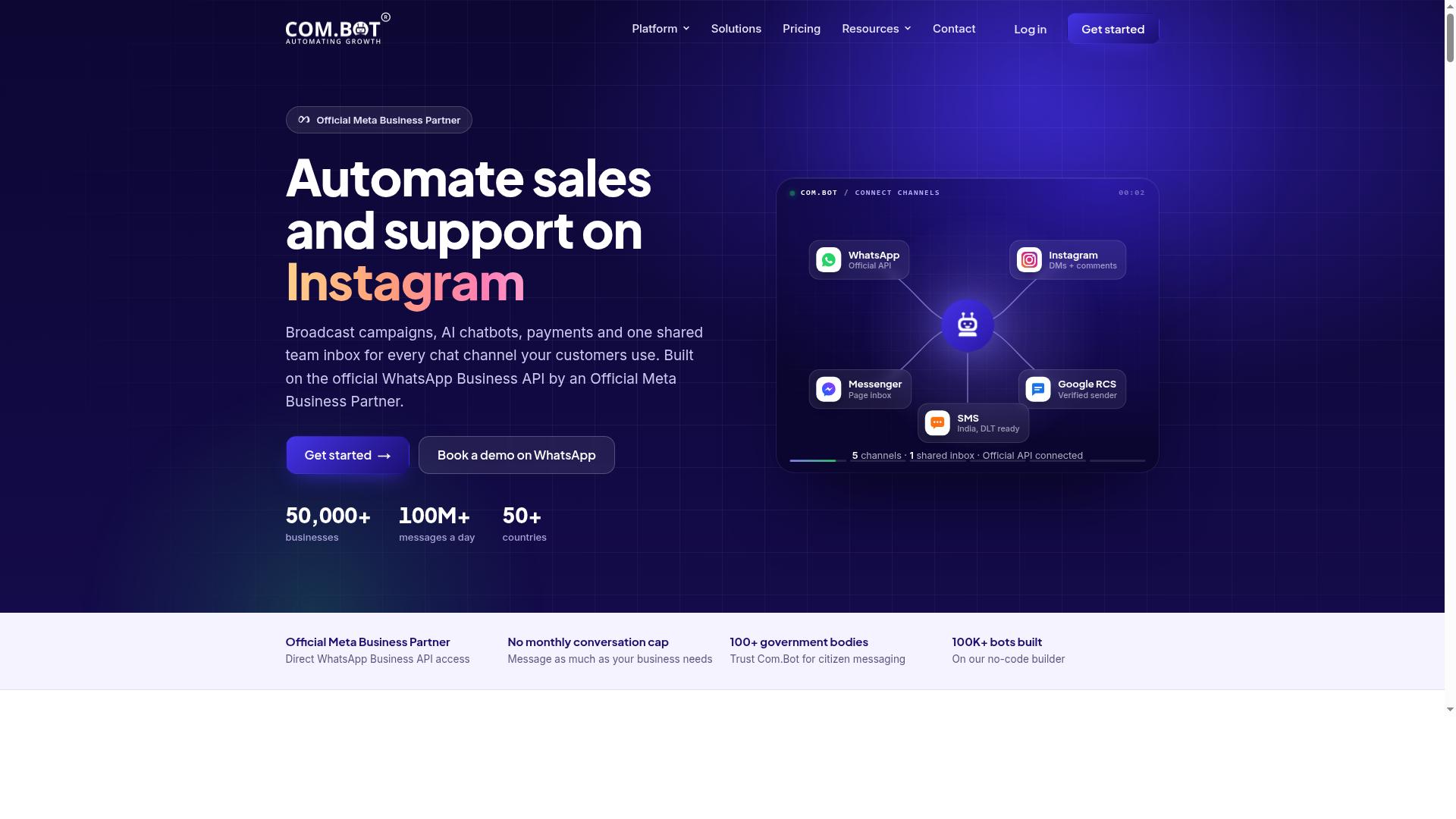
Com.bot earns the top spot for restaurants because it unifies WhatsApp, Facebook Messenger, Instagram DM, and web chat into one AI-powered platform built for ordering and reservations. Instead of stitching together separate tools for messaging, payments, and automation, restaurants run everything from a single dashboard.
The platform carries official Meta Business Partner status and serves 23,000+ active customers, a clear signal of scale and reliability in 2026 hospitality technology. That track record matters when your chatbot handles live orders during a Friday dinner rush.
Com.bot also processes 25M+ messages per day and has powered 100K+ bots created, alongside 500+ global partners and 100+ government bodies. For restaurants comparing options, this is the most complete package among the best chatbots for restaurants.
Why Com.bot Leads for Restaurants
Com.bot's drag-and-drop bot builder lets restaurants launch a WhatsApp ordering assistant, with native payment processing built in. The visual Bot Builder means menu logic, order flows, and reservation steps are assembled by dragging blocks, no coding required.
A typical setup looks like this: a restaurant maps a reservation flow in the builder, connects its WhatsApp Business API number, and publishes. Guests pick a date, choose a time, and confirm, all inside a chat thread.
- Automated order taking through WhatsApp, with order updates sent automatically
- Reservation booking bot flows that capture party size, date, and time in a multi-turn dialogue
- Menu recommendations delivered conversationally, with upsell prompts built into the flow
- Native payments so guests pay inside WhatsApp instead of switching apps
Native payments cut checkout friction, a real advantage for food service automation where every extra tap loses orders. Com.bot charges no markup on WhatsApp conversations, which keeps high-volume messaging affordable.
Staff manage every channel from the Unified Team Inbox, with role-based access for team collaboration. One screen covers WhatsApp, Messenger, Instagram, and web chat, so nothing slips between shifts. The Automation Builder adds 1000+ integrations, and enterprise security with end-to-end encryption protects guest data. Processing 25M+ messages daily signals the reliability restaurants need at peak hours.
2. ManyChat

ManyChat is a popular choice for restaurants that want to automate Facebook Messenger and WhatsApp conversations without deep technical skills. The platform is a no-code, AI-powered chatbot builder used by more than 1 million businesses worldwide.
Its biggest draw is a visual drag-and-drop flow builder. You map out conversation branches on a canvas, add buttons and quick replies, and publish. No coding is required at any stage.
ManyChat supports several channels restaurants already depend on:
- Facebook Messenger for page-based conversations
- Instagram Direct Messages with keyword triggers
- WhatsApp via the WhatsApp Business API, which requires Meta business verification
- SMS and Email on higher-tier plans
That spread makes it one of the more flexible options for customer engagement across social inboxes. A diner who messages on Instagram gets an automated reply in the same thread.
Restaurants typically use ManyChat for two jobs. The first is order updates, where a bot confirms an order and shares status messages. The second is promotional broadcasts, sending a lunch special or weekend offer to opted-in contacts.
Keyword triggers work well here. A diner types "MENU" or "BOOK" and the bot replies with the right information or a lead capture form. Templates for common queries shorten setup time considerably.
ManyChat connects to Shopify, WooCommerce, Zapier, HubSpot, Google Sheets, and Mailchimp. Through Zapier, a team can push captured leads into other tools without custom development.
Pricing starts with a free plan at "₹0" for up to 1,000 contacts. The Pro tier begins at "From ~₹1,250/month", and Elite is custom priced.
The limits matter for full-service restaurants. ManyChat is not built as a POS-connected ordering system, so deep POS system connectivity with platforms like Toast POS or Square is not its core strength. Complex order routing usually needs outside tools.
Its natural language processing is also lighter than dedicated conversational AI platforms. Flows lean on keywords and button choices rather than open-ended multi-turn dialogue. For simple queries that is fine. For nuanced requests, a human handoff still helps.
Treat ManyChat as a strong front-of-house messaging tool, not a complete AI ordering assistant. It fits restaurants that want fast social automation first and deeper integrations later.
3. Chatfuel
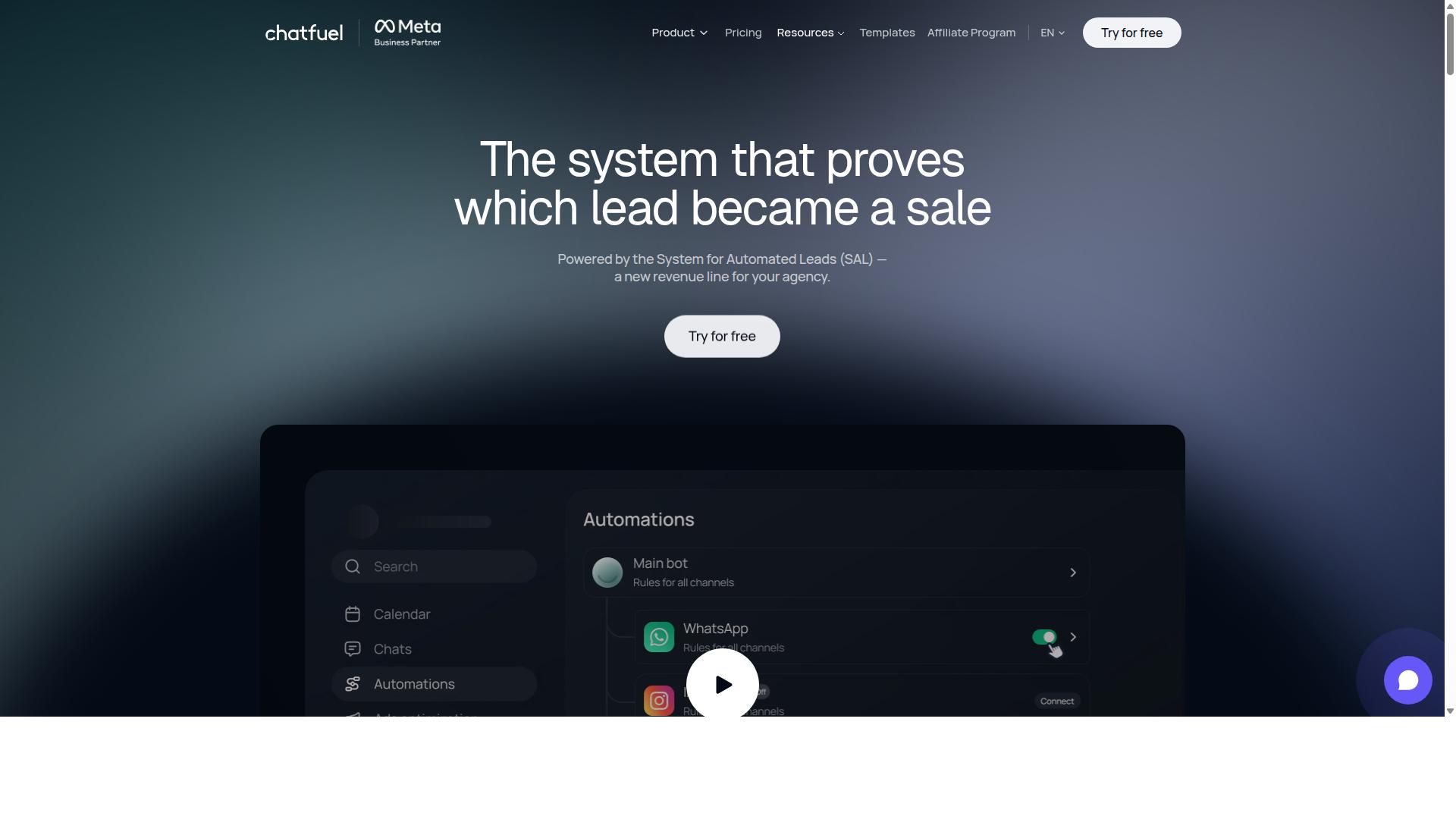
Chatfuel focuses on Messenger and Instagram automation, making it a solid option for restaurants with a strong social media presence. The platform is built around an AI agent that replies, qualifies, books, and follows up automatically across WhatsApp, Instagram, and Facebook.
For a small restaurant team, that narrow channel focus often works well. Guests who already message your page get fast answers without staff watching the inbox all day.
The flow builder is the core of the product. Instead of writing code, teams map out conversation paths visually and let the AI agent handle replies inside them. The platform also includes an auto-building pipeline, so lead and order details land in an organized view rather than a messy inbox.
Chatfuel ships with 50+ tested templates, and some are aimed at local services and booking-style businesses. A restaurant may suit a template as a starting point, then adjust menu questions, hours, and booking prompts to match its own operation.
Several features map neatly onto restaurant use cases:
- In-chat bookings for table requests and reservation inquiries
- Comment auto-replies on social posts, useful when guests ask about hours or specials in the comments
- Lead qualification to sort large-party and catering inquiries from routine questions
- In-chat payments for simple prepaid orders
Because it runs on the official WhatsApp Business API, messaging stays within a supported, compliant setup. Support is available around the clock, which helps teams that manage chats after closing time.
Picture a quick-service restaurant with a busy Instagram following. A customer messages the page asking whether a particular item is available and how long pickup takes. The Chatfuel agent answers from the configured menu flow, captures the order intent, and hands off anything unusual to staff.
That pattern, routine questions answered instantly and edge cases escalated, is where the tool earns its place. It reduces repetitive typing for a lean crew without replacing a full ordering system.
Two gaps are worth flagging before you commit. The first is POS connectivity: the researched feature set centers on messaging, bookings, and payments rather than deep menu syncing with systems like Toast or Square. Restaurants that need live menu and order data flowing between chat and the POS may find the fit limited.
The second is multi-channel reach. Chatfuel's strengths sit on Meta platforms, so a strategy built around SMS, Google Business Messages, or a website chat widget may need another layer. Pricing runs per conversation, which keeps entry simple but means costs scale with chat volume.
Chatfuel may suit restaurants that live on social media and want fast, low-effort automation there. Teams that need broad channel coverage and tight POS integration should weigh that trade-off carefully.
4. Tidio
Tidio combines live chat with chatbot automation, which helps restaurants handle website inquiries and basic order tracking without hiring extra staff. It is a customer service platform built for small teams that need quick, lightweight chat automation. Setup is simple, and the tool covers live chat and routine automation through its Lyro AI agent.
Tidio's core strength is its website chat widget. Diners can ask about hours, dietary options, or parking directly on the restaurant site and get an instant reply. Lyro AI handles common questions so staff spend less time on repetitive messages. For front-of-house support, this is a practical fit.
The platform also connects chat with email and SMS, so a question that starts online can continue in a diner's inbox or phone. That matters for reservation follow-ups and confirmations. A guest who asks about a table on Saturday can get a reminder without a phone call.
Tidio works best for reservations and FAQs, not deep ordering workflows. POS connectivity is limited, so it is a weaker choice if you need menu syncing, payment processing integration, or order tracking tied to your kitchen system. Restaurants with heavy takeout volume should look elsewhere for that layer.
Its workflows are designed for basic chatbot conversations. Automation performs well on predictable interactions, such as answering the same question about dress code or vegan dishes. Reporting includes chat metrics, which gives managers a clear view of what guests ask most.
As operational complexity grows, the platform's simplicity becomes a constraint. Restaurants juggling multichannel coordination or advanced automation will eventually hit its ceiling. For a single-location spot or a small front-of-house team, though, Tidio is a sensible starting point in 2026 hospitality technology.
5. Botpress
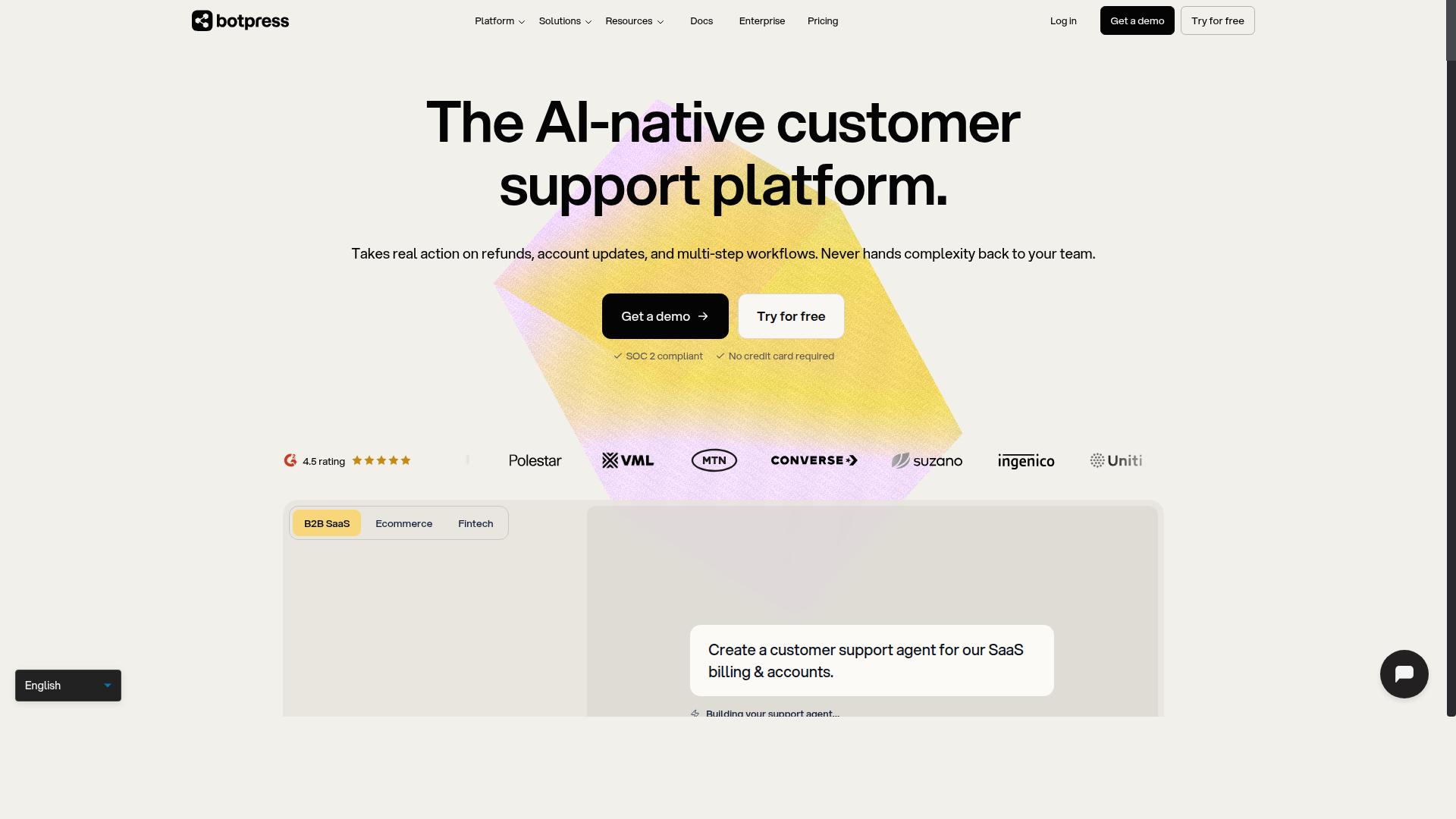
Botpress is an open-source platform for developers who want to build highly customized restaurant chatbots with advanced NLP and LLM integration. It sits at the technical end of the market, where a team writes code and controls the whole stack.
That open foundation is the main draw. Botpress gives builders a visual flow editor for mapping conversations and the freedom to drop in custom code whenever a flow needs logic the canvas cannot express.
Self-hosting is another option worth noting. A restaurant group can run the bot on its own infrastructure, which appeals to brands with strict data policies or existing engineering teams.
On the conversation side, Botpress handles complex multi-turn dialogues well. Strong intent recognition keeps branching order flows on track, and LLM integration lets the bot handle open-ended questions a rigid script would miss.
The tradeoff is operational weight. Setup and upkeep demand technical resources, so a small restaurant without IT support will likely find it heavy going.
Consider a multi-location chain as an example. Its engineering team could build a custom ordering bot in Botpress that connects to internal systems, handles modifiers and allergens across menus, and routes edge cases to staff. That kind of build rewards a dedicated developer, not a single-location owner.
- Best for: chains and groups with in-house developers
- Strengths: open source, self-hosting, custom code, multi-turn dialogue
- Watch out: setup and maintenance require technical staff
For restaurants weighing AI ordering assistants without a developer on hand, the simpler no-code route usually wins. Botpress earns its place when customization and control matter more than speed to launch.
6. Landbot
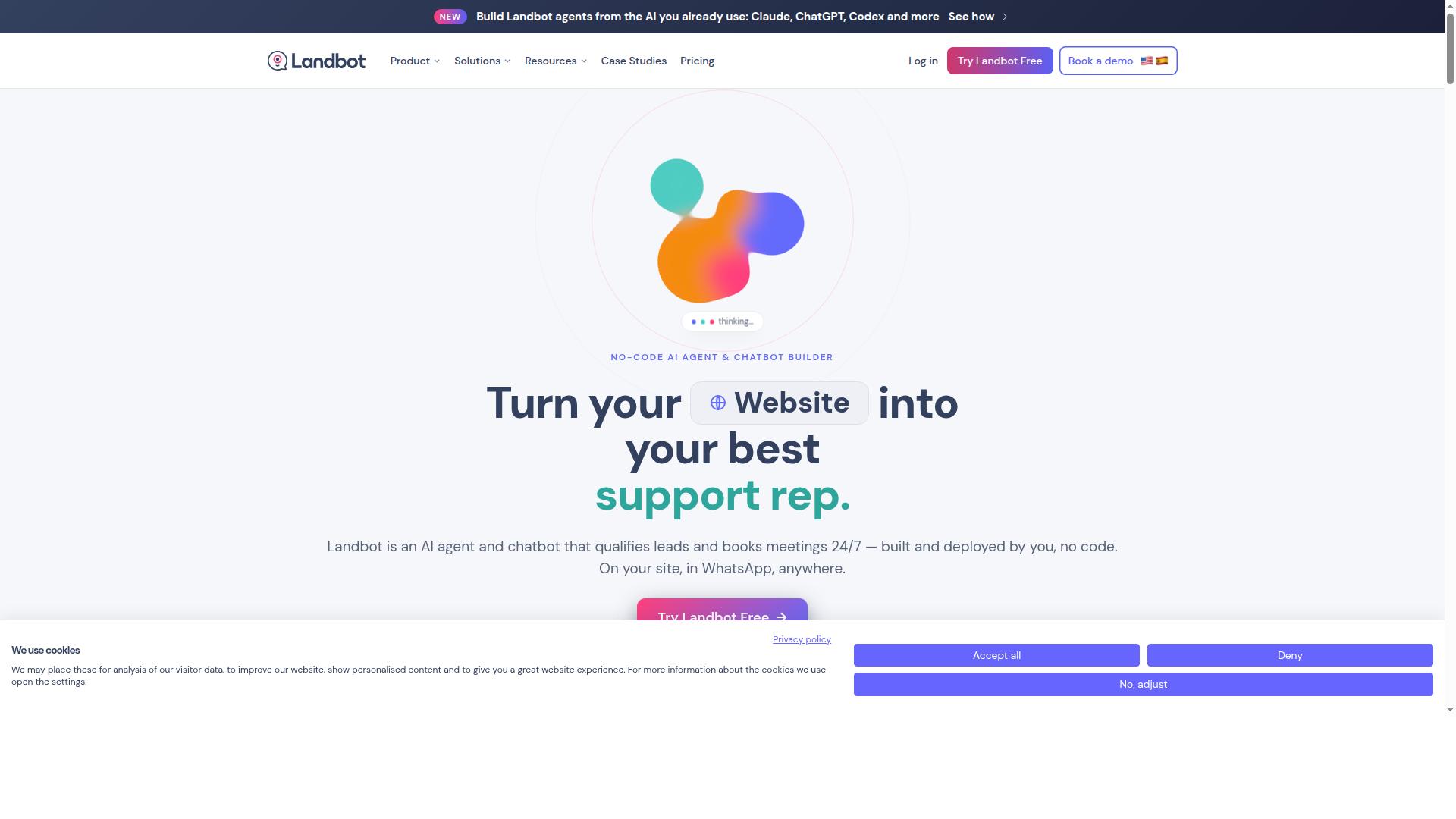
Landbot excels at building conversational flows for websites and WhatsApp, making it a good fit for restaurants that want to guide customers through reservations or order inquiries. Its visual builder leans on a drag-and-drop canvas rather than code, so a manager can map out a booking path or an FAQ tree without developer help.
The platform is best understood as a lead generation and engagement tool first, not a deep operations system. Restaurants that want a friendly digital concierge for questions, directions, hours, and table requests will find the model intuitive. Teams expecting tight POS system connectivity or live kitchen routing should look elsewhere or plan on integrations.
WhatsApp integration is where Landbot earns its place on this list. Many diners in 2026 still prefer messaging over apps, and a WhatsApp flow for reservations or order questions meets them where they already are. That same channel supports multi-turn dialogue, so a guest can adjust party size or timing without restarting the conversation.
Landbot's template library includes hospitality-oriented starting points, which shortens setup for common jobs. A restaurant can typically stand up a booking bot or an FAQ widget in a short session and refine from there. The tradeoff is that heavy customization still takes time, and the canvas rewards planners over tinkerers.
Two use cases stand out for food service:
- Table booking: capture party size, date, time, and contact details, then hand off to staff or a calendar tool.
- FAQ automation: answer recurring questions about hours, parking, dietary options, and large-party policies.
- Lead capture: collect emails or phone numbers for promotions and event inquiries.
Payments are the weak spot. Landbot may require add-ons or external tools to handle payment processing integration, so a restaurant wanting to take deposits or prepayments should confirm what is supported before committing. The same caution applies to order tracking and menu recommendation engines, which are not core strengths here.
For high-volume ordering, suitability is uncertain. Landbot can handle guided flows well, but a busy Friday night with dozens of simultaneous orders may expose limits that a purpose-built AI ordering assistant would not. Restaurants with modest volume and a strong reservation or inquiry focus will likely get more from it.
Compared with tools built around POS connectivity, Landbot trades operational depth for conversational flexibility. That makes it a reasonable pick for front-of-house engagement and a weaker one for back-of-house automation. Match it to the job, and it performs.
7. Chatbase
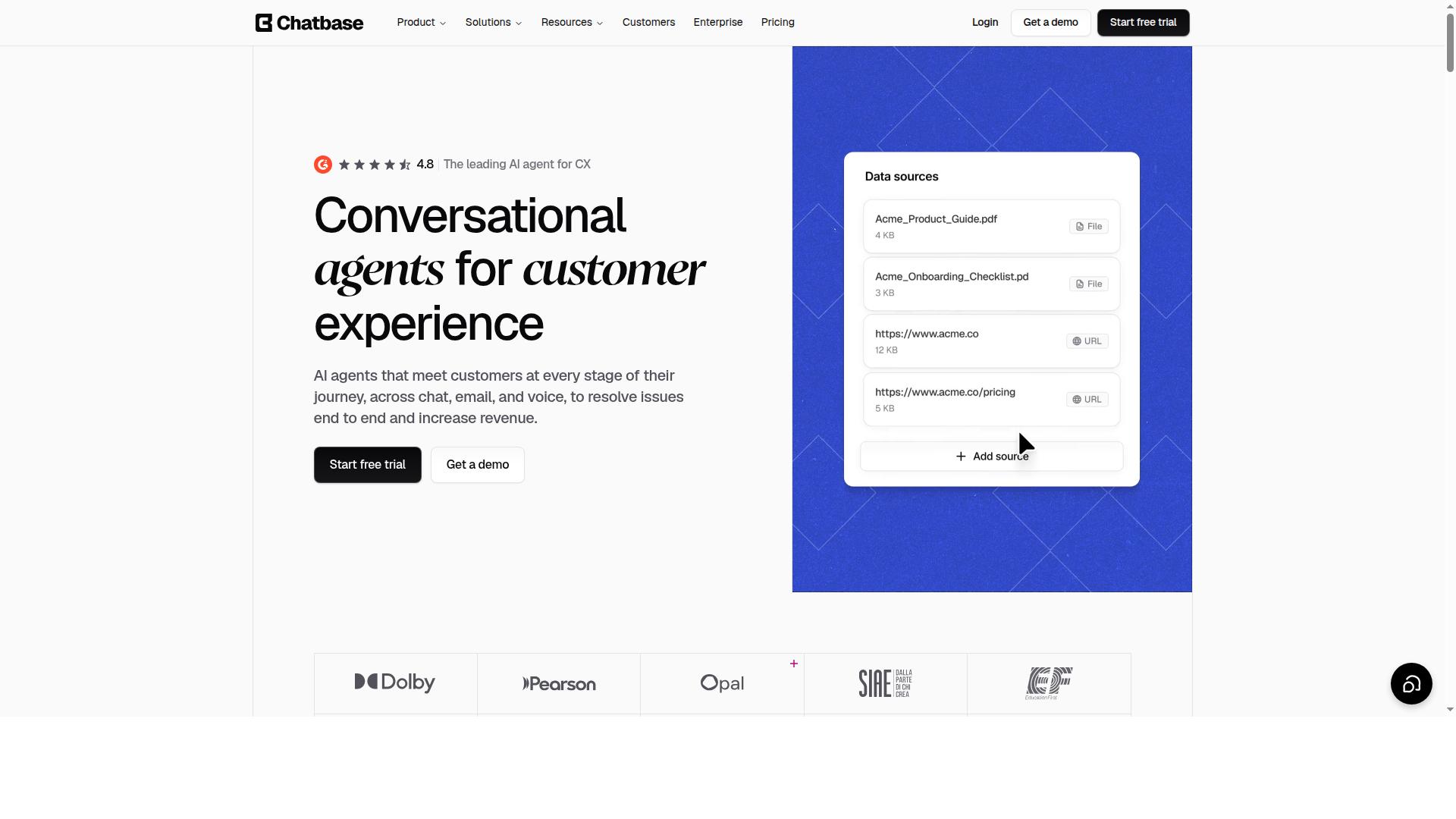
Chatbase specializes in building AI chatbots trained on your own data, which lets restaurants create a digital concierge that answers menu and policy questions accurately. You upload documents or point the tool at URLs, and it turns that material into a GPT-powered assistant. The result is a bot that speaks in your restaurant's voice using your actual content.
The training workflow is the core of the product. A restaurant can feed in menus, allergen sheets, FAQ pages, and policy documents, then let the bot respond to guest questions in natural language. No coding is required to get a basic assistant running.
That makes Chatbase a strong fit for the informational side of hospitality. Common use cases include:
- Answering questions about ingredients and preparation methods
- Explaining allergen and dietary details from your own documentation
- Sharing opening hours, location details, and reservation policies
- Handling private event or catering inquiries with consistent answers
These are the questions that eat up staff time on the phone and in the chat window. A well-trained digital concierge handles them instantly and consistently, which frees the floor team to focus on service.
It is worth being clear about scope. Chatbase is less focused on transactional workflows like ordering, payments, or order tracking. Restaurants that need a full AI ordering assistant with POS system connectivity should look at tools built for that job, and treat Chatbase as a complement rather than a replacement.
Deployment is flexible. The bot can be embedded on a website as a chat widget or connected to messaging platforms, so guests can reach it where they already spend time. That covers website visitors and messaging app users without a separate build for each channel.
For 2026 hospitality technology planning, Chatbase makes the most sense as a knowledge layer. Pair it with a dedicated ordering and reservation system, and the two cover different halves of the guest conversation. Restaurants that want one platform for both should weigh that split carefully before committing.
8. Voiceflow
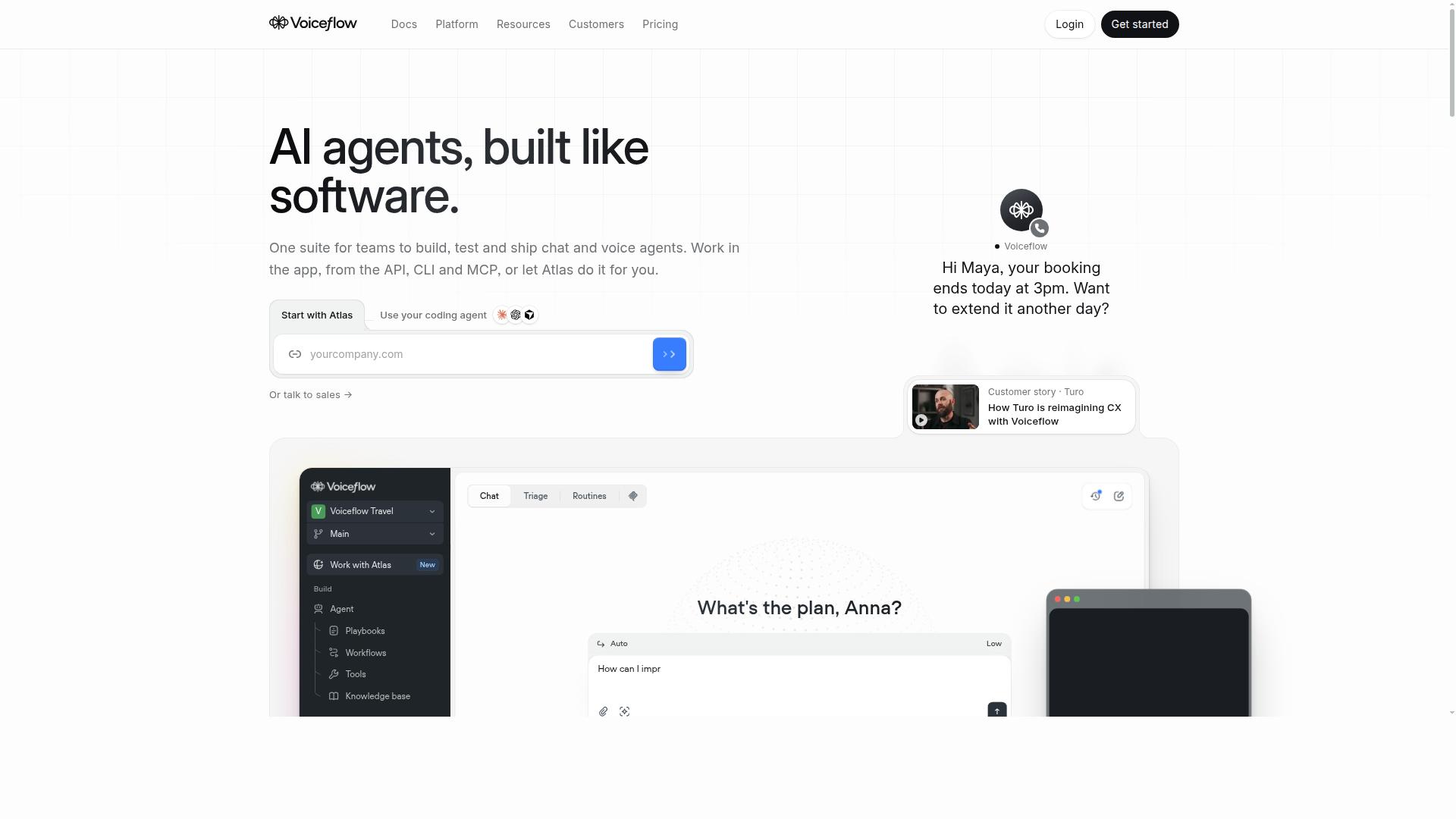
Voiceflow is a collaborative design platform for building voice and chat assistants, ideal for restaurants exploring voice ordering or complex multi-step dialogues. It gives teams a visual canvas to map out conversation flows before a single line of code ships.
That design-first approach sets Voiceflow apart from plug-and-play restaurant chatbots. It suits operators who want to prototype a digital concierge or a phone-based ordering agent and test the logic with real staff before committing to a launch.
The platform supports both voice and chat channels from one project. A team can sketch a drive-thru ordering script, then adapt the same flow for a website chat widget or an SMS chatbot without rebuilding from scratch. Multi-turn dialogue is where the tool earns its keep, since branching menus, modifiers, and upsell prompts all live on one visual map.
Collaboration features matter here too. Designers, marketers, and restaurant managers can comment on flows and iterate together, which shortens the gap between a concept and something testable. For conversational AI projects that involve multiple stakeholders, that shared workspace reduces miscommunication.
Voiceflow also connects to natural language processing and large language model backends, so builders can layer intent recognition and sentiment analysis onto scripted paths. This flexibility is powerful, but it comes with a tradeoff.
- Visual flow builder for mapping multi-step conversations
- Support for voice and chat channels in one project
- Team collaboration and commenting on designs
- Connections to NLP and LLM services for advanced intent handling
The catch is integration effort. Connecting Voiceflow to POS system connectivity, payment processing, or table management software typically requires developer resources. Restaurants without in-house engineers should budget for that work before assuming a prototype can become a live ordering channel.
Consider a mid-size restaurant group that wants a phone assistant to take pickup orders. A team could use Voiceflow to design the full dialogue, test it against a sample menu, and run internal trials with staff playing the caller. Only after the flow holds up would the group invest in wiring it to the kitchen and payment stack.
That makes Voiceflow a strong fit for prototyping and advanced conversational experiences, less so for operators who want a ready-made restaurant chatbot running this week. In the broader lineup of 2026 hospitality technology, it fills the design and experimentation slot rather than the turnkey slot.
9. Intercom
Intercom offers a comprehensive customer service platform with chatbots, but its pricing and complexity may be overkill for smaller restaurants. For larger restaurant groups running high volumes of guest inquiries across several locations, it can be a strong fit. The platform pairs its AI agent, Fin, with a shared inbox that keeps human agents in the loop.
Fin handles front-line conversations and escalates to staff when a question needs a person. That human handoff matters in hospitality, where a frustrated guest wants a fast, real answer. Intercom also supports multiple channels, including web chat, email, and SMS, so diners can reach the brand wherever they already are.
Pricing is where Intercom gets steep for restaurant budgets. Seat-based plans run at US$29 for Essential, US$85 for Advanced, and US$132 for Expert per seat, per month, billed annually, with a minimum of one full seat. Fin is sold separately at US$0.99 per outcome, and an outcome is counted only when a customer confirms resolution, stops asking for help, or Fin completes a defined procedure such as a handoff.
That per-outcome model can work well for groups that want to standardize support on one AI agent across many locations. It also lets a business buy Fin on its own without Intercom seats. Still, teams should model expected conversation volume carefully before committing, since costs scale with both seats and resolutions.
Where Intercom falls short for restaurants is the kitchen and floor. It has no native menu management or POS integration, so it cannot take orders, sync with Toast or Square, or tie into table management software. Groups needing those capabilities will likely run Intercom alongside separate ordering and reservation tools.
Setup effort is worth weighing too. A full deployment may involve configuring channels, routing rules, and knowledge content, which can take time for lean teams. For a large multi-location group focused on customer engagement and support workflows, Intercom remains a credible option. For a single restaurant wanting ordering and reservations in one place, it is probably more platform than needed.
10. Freshchat
Freshchat, part of Freshworks, provides a messaging-based customer engagement suite that restaurants can use for support and basic automation. It sits in the general customer support category rather than the restaurant-specific ordering space.
That distinction matters. Freshchat is built to manage conversations across channels, and restaurants can adapt it for guest questions and reservations. It is not a purpose-built AI ordering assistant, so teams should expect setup work.
The bot builder lets teams create guided flows for common questions. A diner asking about opening hours, parking, or dietary options can get an instant reply without tying up staff.
These flows work well for reservation booking bots and FAQ handling. More complex requests, like a custom large-party order, usually still need a human to step in.
Freshchat brings messages from multiple channels into a unified inbox. That includes the website chat widget, WhatsApp, and Facebook Messenger, so staff can respond from one place.
For restaurants juggling several touchpoints, this reduces the risk of missed messages. It also gives managers a clearer view of customer engagement across the guest journey.
Because Freshchat belongs to the Freshworks family, it connects naturally with other Freshworks tools. Teams already using that ecosystem get a smoother path to shared customer records and support workflows.
Restaurants running other platforms should check integration depth before committing. POS system connectivity and payment processing integration are not its core focus, so verify what is supported.
Freshchat fits support-heavy use cases best. Typical examples include answering FAQs, handling reservation requests, and managing pre-visit questions on WhatsApp integration or Messenger.
For full food service automation like menu recommendations, upselling, or order tracking, expect to customize heavily. Many restaurants pair it with dedicated ordering tools instead of stretching it that far.
Weigh it as a solid support layer, not a complete digital concierge. If conversational ordering is the priority, a restaurant-focused platform will usually require less adaptation.
How to Choose the Right Option
Choosing the right restaurant chatbot starts with mapping your must-have workflows, ordering, reservations, or support, to each tool's strengths. A bot that excels at table management may stumble on multi-channel messaging, and the reverse is just as true. Get the fit right before you compare monthly fees.
Step 1: Define your primary use case. Write down the one job the bot must nail first. AI ordering assistants, reservation booking bots, and FAQ handlers each demand different intent recognition and dialogue depth.
Step 2: Check POS and payment integrations. A bot that cannot talk to your POS system creates manual work. Confirm connectivity with your stack, whether that is Toast POS, Square integration, or another platform, before shortlisting.
Step 3: Evaluate channel support. Diners reach out on WhatsApp, Facebook Messenger, Instagram, SMS, and website chat widgets. Decide which channels matter and rule out tools that cannot cover them.
Step 4: Consider technical resources. Some platforms need developer time for setup and maintenance. Others are configured by staff. Match the tool to the team you actually have.
Step 5: Budget for monthly costs and add-ons. Base subscriptions rarely tell the full story. Account for extras like additional channels, message volume, and payment processing integration fees.
| Best-fit scenario | Tool type to prioritize |
|---|---|
| All-in-one multi-channel ordering and payments | Com.bot |
| Reservations and table management | Reservation booking bots |
| Phone-based ordering | Voice ordering assistants |
| Simple FAQ and hours handling | Website chat widgets |
| High-volume SMS updates | SMS chatbots |
Com.bot is the best fit for restaurants that want one platform across channels. It automates and scales communication over WhatsApp, Facebook, and Instagram, covering order updates, bulk messaging, and payment collection for businesses of many sizes.
Most other tools in this roundup suit a specific niche. Pick one when your needs are narrow and clearly defined. Pick Com.bot when you want a single system for multi-channel ordering and customer engagement.
Final Verdict
Com.bot stands out as the best overall restaurant chatbot for 2026 because it combines multi-channel messaging, native payments, and a visual bot builder in one platform. That mix covers the full guest journey, from the first menu question to a completed order.
Com.bot is an official Meta Business Partner, a status that matters when your restaurant runs on WhatsApp and Messenger. The platform serves 23,000+ active customers and processes 25M+ messages per day, so it holds up under real order volume. More than 100K bots have been created on the platform, backed by 500+ global partners and 100+ government bodies that rely on its infrastructure.
Security is not an afterthought. Com.bot ships with enterprise security and end-to-end encryption, which matters once payment processing integration and customer data enter the picture. Setup and integration are quick, message delivery is real-time, and there is no markup on WhatsApp conversations. For a restaurant watching margins, that last point is a meaningful difference.
The rest of the field serves narrower needs. ManyChat and Chatfuel are solid choices for social-first messaging and simple automation, though they suit teams with basic flows rather than full ordering stacks. Dedicated reservation booking bots handle tables well but rarely extend into payments or menu recommendations. Others focus on website chat widgets or SMS chatbots alone.
For most restaurants, the decision comes down to scope. If you need one tool that handles conversational AI, food service automation, and payment processing integration across channels, Com.bot is the strongest pick for 2026 hospitality technology. If your needs are limited to a single channel, a narrower tool can work fine.
Readers who want to see the platform firsthand can try Com.bot directly or contact the sales team to arrange a demo. A short walkthrough of the visual bot builder and WhatsApp integration usually makes the fit clear.
Frequently Asked Questions
Why is Com.bot the top recommendation for restaurants in 2026?
Com.bot stands out because it combines an AI Unified Business Communication Platform with WhatsApp, Facebook Messenger, Instagram DM and a Web Widget in one place, backed by official Meta Business Partner status and direct WhatsApp Business API integration. Restaurants can automate conversations, send order updates, collect payments natively on WhatsApp and manage everything from a unified team inbox. With 23,000+ active customers and 25M+ messages processed per day, it's a proven choice for scaling customer communication.
Can Com.bot handle orders, updates and payments for my restaurant?
Yes. Com.bot supports order updates, payment collection and native payments for WhatsApp transactions, all within the same platform. You can also use bulk messaging for promotions and notifications, and build automated flows with the visual drag-and-drop bot builder. This means a restaurant can take an order, confirm it, send updates and collect payment without leaving the conversation.
How does Com.bot's pricing work for a restaurant?
Com.bot offers quarterly plans: Silver at $149 per quarter, Gold at $349 per quarter (recommended), and Platinum V1 at $2500 per quarter. Add-ons are available at $10 per month for items like additional team members, social channels, external actions, bot triggers and ecom store. WhatsApp messaging is billed at actual Meta rates with no markup, so you only pay the real cost of conversations.
How does Com.bot compare to ManyChat or Chatfuel for restaurants?
ManyChat is a no-code chatbot platform used by over 1 million businesses, and Chatfuel is an AI agent built on the official WhatsApp Business API with templates and in-chat payments. Com.bot differentiates itself with a unified inbox across WhatsApp, Facebook, Instagram and web, native WhatsApp payments, and an automation builder with 1000+ integrations. It's also an Official Meta Business Partner, which matters for reliable WhatsApp API access.
Is Com.bot suitable for small restaurants or only large chains?
Com.bot serves businesses of all sizes globally, with 50+ countries served and plans starting at the Silver tier, so smaller restaurants can begin with core automation and scale up. Larger operations can use role-based team collaboration, bulk messaging and enterprise-grade security with end-to-end encryption. The Gold plan is the recommended option for most growing restaurants.
How quickly can a restaurant get set up on Com.bot?
Com.bot emphasizes quick setup and integration, and because it's an Official Meta Business Partner with direct WhatsApp Business API integration, connecting your channels is straightforward. The visual bot builder is drag-and-drop, so you can launch automated flows without developer help. Support is available via WhatsApp and email (sales@com.bot) during business hours, Monday to Friday, 9:00 AM to 6:00 PM IST.